Channel Letter Signs for NYC Storefronts: Types & Buying Guide.
What goes inside a commercial channel letter sign, how the four lighting architectures perform after dark on Brooklyn and Manhattan blocks, how to calculate readable letter height, and what permits to expect.

Channel letters are individually fabricated 3D metal characters wired with UL-listed LEDs inside each letter body. Front-lit acrylic letters maximize bright block-long visibility; reverse halo-lit letters bounce warm LED glow off brick or stone for upscale or landmark blocks. Starter custom sets in NYC begin near $1,500, with total pricing driven by letter height, count, lighting type, mounting method, and DOB permits.
How Commercial Channel Letters Are Built in Brooklyn
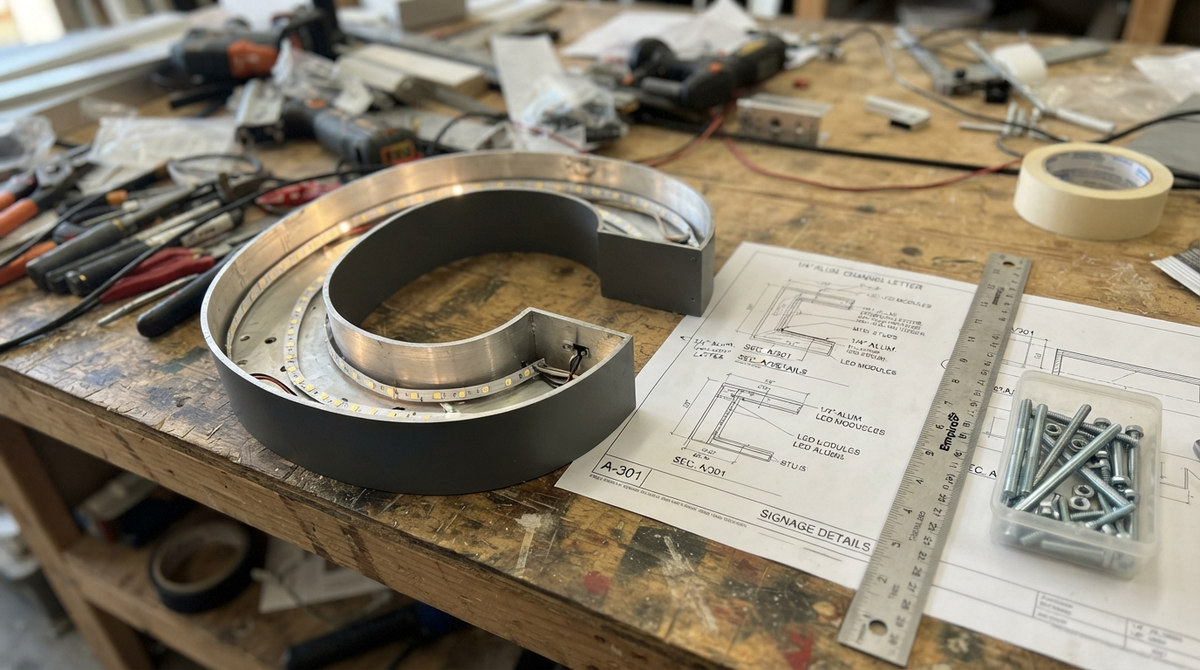
Every commercial channel letter consists of four coordinated parts: a laser-cut or routed aluminum back plate, a 3-inch to 5-inch coiled 3003 aluminum return formed to track every curve and serif, a rigid 1/8-inch cast acrylic or solid metal face locked inside jewel-trim cap molding, and sealed 24V UL-listed LED modules bonded inside.
Because NYC corners absorb year-round coastal humidity, snow salt, and pigeon roosting, we avoid porous steel returns that streak storefront marble with rust. Everything runs through exterior automotive paint systems and feeds into concealed Class 2 waterproof power supplies.
The Four Channel Letter Lighting Styles Compared
Match the lighting behavior to your storefront street conditions, evening hours, and landlord guidelines.
| Lighting Style | How Light Emits | Typical Mounting & Cost Signal | Best NYC Business Fit |
|---|---|---|---|
| Front-Lit | Pigmented translucent acrylic face glows forward cleanly | Flush pin or painted raceway; most budget-efficient lit build | Pharmacies, bakeries, cafes, urgent cares, franchise retail |
| Halo-Lit (Reverse-Lit) | Solid aluminum or brass face stands off wall so LEDs glow behind onto masonry | Threaded standoff pins on brick/stone; mid-to-premium tier | Law firms, medical studios, brownstone dining, LPC blocks |
| Combination-Lit | Both translucent glowing front face AND rear perimeter halo glow simultaneously | Flush or backer panel with internal clear diffuser backs | Cocktail lounges, flagship showrooms, busy corners |
| Open-Face | Clear acrylic protective lens or open cavity exposing LED filament or vintage neon | Deep pan returns; custom exposed tube/wire routing | Music venues, retro bars, craft hospitality concepts |
Raceway vs Flush Mount & Reading Distance Math
Two early decisions—wall penetrations and letter height—dictate both landlord approval speed and real sidewalk visibility.
Flush Mount vs Extruded Raceway
Flush mounting threads pins directly into the facade for a pure clean look. If a landlord restricts drilling into historic masonry or glazing mullions, a slim paint-matched raceway houses every transformer wire and anchors with just 6 to 8 bolts.
- Clean Look: Flush
- Min Wall Holes: Raceway
Letter Size & 1" = 10 ft Rule
Standard exterior signage visibility follows a simple 1-inch letter height per 10 feet of distance rule: 12" letters read sharply at ~120 ft; 18" letters pull traffic across wide 4-lane avenues at ~180 ft without crowding the transom.
- 12" = ~120 ft
- 18" = ~180 ft
- 24" = ~240 ft
UL 48 Certification & NYC Power
Every illuminated letter set requires UL-listed modules, Class 2 waterproof drivers inside accessible enclosures, and an exterior kill/disconnect switch matching NYC Electrical & Building Code requirements.
- 120V Feed to Sign
- Class 2 24V Drivers
- Shutoff Accessible
Timeline, Permitting & Lifecycle Maintenance Overview
Typical project durations and care guidelines from initial facade photo to long-term operation.
| Project Stage | What Happens | Typical NYC Range | Owner Action |
|---|---|---|---|
| 1. Survey & Drawings | Facade laser measurement, color swatch check, scaled rendering | 2–4 Business Days | Provide lease sign clause & hi-res vector logo |
| 2. DOB / LPC Filing | Zoning calc, structural wind drawings, DOB permit (or LPC landmark review) | 2–6 Weeks (DOB); +LPC if historic | Sign landlord owner authorization forms cleanly |
| 3. Shop Fabrication | CNC routing, aluminum return forming, automotive finish, UL LED wiring | 10–15 Business Days | Coordinate 120V junction whip inside soffit/facade |
| 4. Budget & Ongoing Care | Started from $1,500 small runs; wipe acrylic twice yearly; swap 24V drivers every 5–8 yrs | $1,500–$6,500+ installed | Put illuminated signs on astronomical dusk-to-dawn timer |
4 Field Rules Every NYC Owner Should Know
Avoiding costly lease or inspection rejections starts before ordering hardware.
Check LPC Maps First
Blocks in SoHo, Brooklyn Heights, Cobble Hill, and Greenwich Village fall under Landmarks Preservation Commission review—pin-mounted halo or non-lit metal approves far smoother than bright plastic boxes.
Keep 1.5" Minimum Stroke
Overly thin serif fonts choke inside 3/4" metal returns; keep bold strokes at least 1.5" wide so LED modules distribute light evenly without hotspots.
Match Masonry Mortar
Paint raceways or backer panels to match sandstone or storefront cornice charcoal so hardware disappears visually.
Keep 24V Access Simple
Never bury transformers permanently behind drywalled soffits; keep a removable driver box inside an interior closet or hinged fascia hatch.
Explore Related Guides & Sign Categories
Connect directly with fabrication specifications, borough permit requirements, or other NYC planning guides.
Custom Channel Letters Service
See our live Brooklyn fabrication specs, gallery photos, and order your custom storefront proof.
NYC Sign Rules & Zoning Guide
Read the full Zoning Resolution area formulas (C1–C8), 12" vs 18" projection rules, and Licensed Sign Hanger criteria.
How Much Does an NYC Sign Cost?
Compare real starting budgets for flat aluminum, lightboxes, awnings, and channel letters.
Channel Letter Buyer's Guide FAQs
Quick answers for new retail and restaurant openings.
Are front-lit or halo-lit letters brighter at night?
Can channel letters mount cleanly onto a thin ACM signboard backer?
Do NYC landmarks blocks prohibit illuminated channel letters?
How much power do LED channel letters pull per month?
What minimum clearance is required above the storefront sidewalk?
How do I start a channel letter permit and proof with BK Signage?
Have a Facade Photo? Ask Our Channel Letter Estimators
Get clear sizing math, lease feedback, and honest installed pricing before signing off on your storefront opening schedule.
- Exact Street Zoning Check Included We tell you clearly if your facade qualifies in C1/C2 or commercial corridors.
- Raceway vs Flush Comparison Side-by-side pricing and wall anchor count so your landlord approves faster.
- Written NYC DOB Guidance Zero surprise permit fees or unlicensed install headaches.
Ask a Sign Maker or Request a Estimate
Send your storefront address, rough dimensions, or permit question directly to our Brooklyn estimating team.
Ready to Price or Permit Your NYC Sign?
Share a photo of your facade or wall and we will prepare a scaled drawing, code check, and itemized estimate from our Brooklyn shop.